· Giraffe
Store policies for Singapore Shopify stores
Store policies tell customers how you handle returns, delivery and their personal data. Shopify requires some of them, Singapore law shapes what they can say, and clear policies prevent disputes. This guide covers which policies you need, what to put in them and how to set them up.
This is general information, not legal advice. For anything unusual, have a lawyer review your policies.
What Shopify requires
Under the Shopify Terms of Service, you must show public-facing:
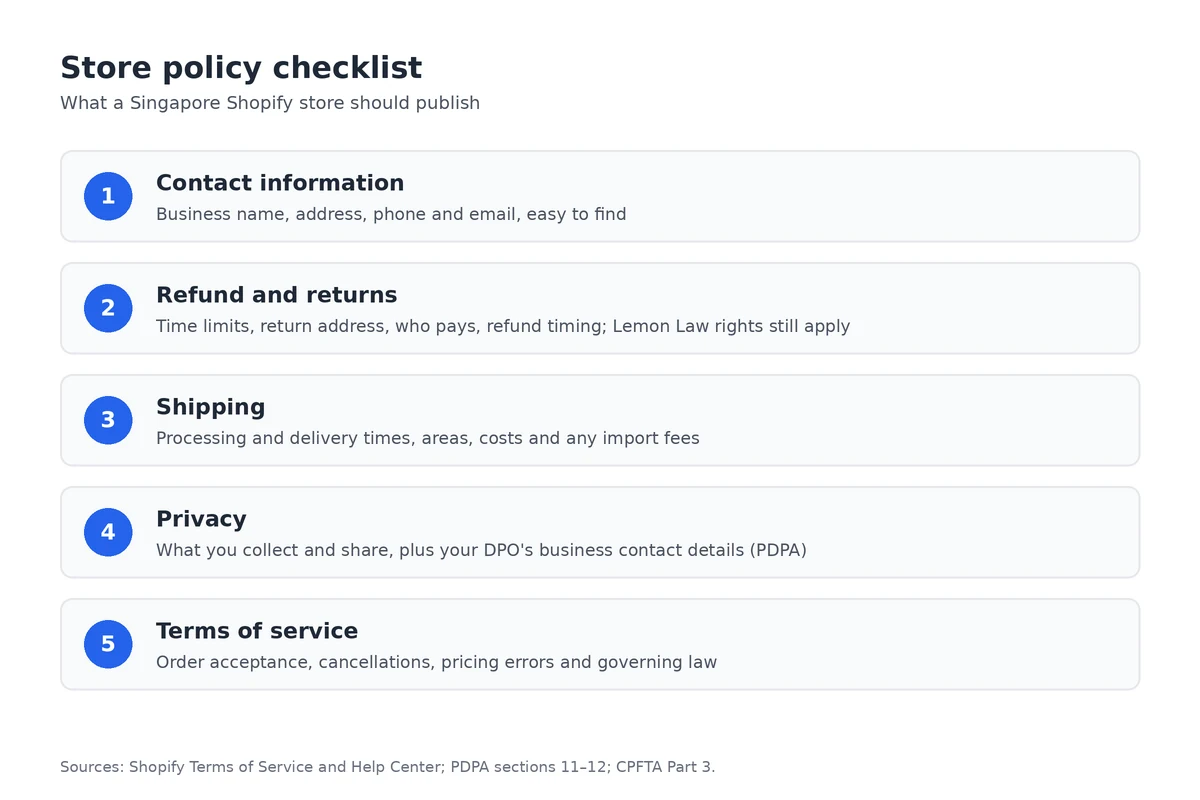
- contact information: your name, address, phone number and email;
- terms of service;
- a refund policy;
- shipping policies, including order fulfilment timelines.
Shopify's consumer protection page says this information must be current, accurate and easy to find, and its dropshipping page warns that failing to provide an accurate refund policy can lead to action against your account.
Setting policies up
Go to Settings > Policies. Shopify's store policies page lists return, privacy, terms of service, shipping, legal notice, contact information and subscription policies. For supported policies, automated versions pull details such as your address and return rules from your settings, so they stay up to date. Always read the published result: automated text won't know Singapore rules or your actual practices.
Link the policies in your footer as well as at checkout.
Refund and return policy
Shopify suggests including:
- how long customers have to return items;
- the return address;
- who pays for return shipping;
- how long refunds take;
- who to contact if a refund is late.
Your policy can't take away statutory rights. Under Part 3 of the CPFTA, Singapore's Lemon Law, consumers can require repair or replacement of goods that don't conform to the contract at delivery, and if that fails or isn't possible, a price reduction or to rescind the contract (section 14). Defects that appear within six months of delivery are generally presumed to have existed at delivery. See our returns, refunds and Lemon Law guide.
Shipping policy
State processing times, delivery times by method, delivery areas and costs. Shopify says you must tell customers about shipping times and extra fees, including import duties, before they buy. Make sure the times match what your couriers deliver; see our shipping guide and selling overseas guide. The CCS's price transparency guidelines also expect unavoidable charges to be shown upfront.
Privacy policy and the PDPA
The PDPA requires you to:
- designate someone responsible for compliance (a data protection officer) and make their business contact information public;
- develop data protection policies and a complaints process, and make information about them available on request.
The PDPC summarises these as the accountability obligation. Your privacy policy is the natural place for this: what you collect, why, who you share it with (couriers, payment providers, apps), and how to contact your DPO. See our PDPA guide.
Terms of service and contact information
Terms cover how orders are accepted, pricing errors, cancellations and governing law. Your contact page should list your business name and real ways to reach you; see our ACRA registration guide for your business details. If you sell subscriptions or pre-orders, add their terms too.
Keep policies true
A policy that says "ships in 1–2 days" when it takes a week is a problem in itself. Review policies whenever you change couriers, apps or return rules, and keep staff who handle customer data aware of them; see our store security guide.
Frequently asked questions
Which store policies does Shopify require?
Shopify's Terms of Service require public-facing contact information, terms of service, a refund policy and shipping policies, including order fulfilment timelines. Contact information should include your name, address, phone number and email.
Can Shopify write my policies for me?
Shopify can generate automated policies for returns, terms of service, shipping and contact information that update from your store settings. Review them before publishing, because they won't know Singapore-specific rules or how you actually work.
What should a Singapore privacy policy cover?
Explain what personal data you collect, why, and who you share it with, and give the contact details of your data protection officer. The PDPA requires you to make a DPO's business contact information available to the public.
Can my refund policy say 'no refunds'?
A policy can't remove rights customers have under Singapore law. Under the Lemon Law, consumers can ask for repair or replacement of goods that don't conform to the contract, and in some cases a price reduction or a refund, whatever your policy says.
Starting a new store? A Shopify trial lets you generate and edit your store policies in Settings > Policies and check how they appear at checkout.
References
Rules, features and fees change, so check the live page before you act on anything here.
- Shopify Terms of Service, Shopify. Accessed 22 October 2026.
- Consumer protection laws, Shopify Help Center. Accessed 22 October 2026.
- Adding store policies, Shopify Help Center. Accessed 22 October 2026.
- Dropshipping, Shopify Help Center. Accessed 22 October 2026.
- Personal Data Protection Act 2012, sections 11 and 12, Singapore Statutes Online. Accessed 22 October 2026.
- Data protection obligations, Personal Data Protection Commission. Accessed 22 October 2026.
- Guidelines on Price Transparency, Competition and Consumer Commission of Singapore. Accessed 22 October 2026.
- Consumer Protection (Fair Trading) Act 2003, Part 3, Singapore Statutes Online. Accessed 22 October 2026.
- Consumer Protection (Fair Trading) Act 2003, section 14, Singapore Statutes Online. Accessed 22 October 2026.